Fermilab Finds Antimatter Clues in Quick-Change Particle

Fermilab B mixing UK authorsUK scientists have participated in a recent announcement at Fermilab in the US, revealing some exciting new data on the properties of a subatomic particle known as the "B sub s". The results suggest that the particle oscillates between matter and antimatter in one of nature's fastest rapid-fire processes - more than 17 trillion times per second.

One of the greatest mysteries of the universe is its apparent composition of only matter, and not antimatter. If matter and antimatter were created equally at the time of the Big Bang, matter and antimatter should have annihilated into pure energy. Clearly, this did not happen. How did our universe of matter survive? Laboratory experiments make it possible to observe some forms of matter oscillating into anti-matter and back. Studying such processes can help solve the mystery of the imbalance of matter in the universe, and DZero has made important progress in this direction. Their findings may affect the current view of matter-antimatter asymmetry, and might also offer a first glimpse of the contributions of new physics, such as supersymmetry, to particle physics.

The DZero result, suggesting a preferred oscillation frequency between 17 and 21 times per picosecond (trillionth of a second), is described in a paper submitted to the journal, Physical Review Letters. The result, a measure of the oscillation or "mixing" frequency of the particle, has a confidence level of 90 percent, and so does not qualify as a discovery. Physicists have agreed that claims of a discovery must have a confidence level of 99.99995 percent, indicating a 99.99995 percent chance that the result can be reproduced.

The data for the DZero result were culled from one inverse femtobarn of total collision data, or more than one billion particle collision events from Fermilab's Tevatron particle accelerator. This amount of data is a significant milestone, capitalizing on major operating improvements in the Tevatron. The DZero result also sets the stage for future results. Within the next month or so, the CDF collider detector collaboration at Fermilab expects to have a result with greater precision than the DZero result.

Professor Terry Wyatt of the University of Manchester is the co-spokesperson for the DZero Experiment at Fermilab. He says that "measuring the B sub s oscillation frequency is one of the most important goals at the Tevatron. This result represents a very important step by the Dzero experiment towards that goal. This success has been made possible by the efforts of very many people, in particular those who operate the experiment and the accelerator, as well as those who have performed a very sophisticated analysis of the data."

Read the full press release on the Fermilab press pages

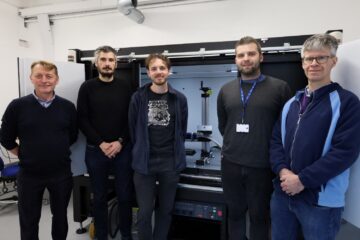
Photograph features some the UK authors of the B sub s result announcement - clockwise starting from top left: Phil Lewis (Imperial College London), Rick Jesik (Imperial College London), Guennadi Borissov (Lancaster), Sergey Burdin (Fermilab, soon to be with Liverpool), Andrei Nomerotski (Fermilab, now at Oxford).  Please contact Rick Jesickfor permissions to use photograph.